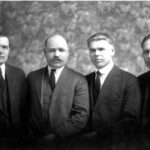
In 1918 a group of radical Ukrainian-Canadian leftists including members of the Social Democratic Party of Canada and staff of the newspaper Working People decided to build a labour temple in Winnipeg: a venue where he city’s left wing Ukrainians could hold political meetings, stage concerts and plays, print books, pamphlets and newspapers. The founders also created the Ukrainian Labour Temple Association (UTLA) to oversee the contruction and operation of the Winnipeg temple. The Association eventually became a national body, building and managing scores of similar temples across Canada. The Social Democratic party of Canada, its Ukrainian section, and its newspaper Working People were outlawed in the fall of 1918 but the UTLA carried on. The Winnipeg temple was completed in early 1919.
The leaders of the ULTA openly sympathized with efforts to establish a Soviet regime in Ukraine. During the 1920s, the ULTA benefited from its identification with Soviet Ukraine which at that time was a thriving, largely independent republic within the Soviet Union. ULTA leaders went to Ukraine to meet Communist party leaders, state officials and prominent writers and artists and became outspoken defenders of the Soviet regime in Canada.
By the early 1920s ULTA leaders were also actively involved in establishishing a communist political party – the Workers Party of Canada (WPC) later renamed the Communist Party of Canada (CPC). The ULTA was formally affiliated with the CPC. The Ukrainian Labour News, which was published at the Winnipeg temple, became an official party channel. UTLA leaders were elected to the Communist Party’s central committee. All ULTA members were expected to participate in fund-raising campaigns in support of the party. By 1924 Ukrainian CPC members controlled the ULTA (now renamed the Ukrainian Labour-Farmer Temple Association or ULFTA) and its affiliated organizations through party caucuses in all of the association’s branches.
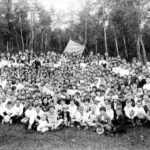
In the years leading up to WWII the ULFTA was the largest and best organized Ukrainian Canadian community centre in Winnipeg. It provided members with a broad array of cultural, recreational and financial services. A women’s section was established in 1922 focusing on fundraising (picnics, socials, bazaars ,lotteries) and women’s education (literacy, book clubs, publications, adult studies, handicrafts.) By 1929 there were over 500 women’s section members in Winnipeg. Children’s programs were introduced at the Winnipeg temple in 1919. They fostered children’s Ukrainian identity by providing instruction in Ukrainian language and exposure to Ukrainian music, singing, dancing and handicrafts. Larger schools, including the one in North End Winnipeg, established girls’ mandolin orchestras, which embarked on local and national tours. The schools were also a channel for communist propoganda, teaching working class children that “they are the children of an enslaved and exploited class.” They presented a romanticized vision of life in the Soviet republics, held up as models to be emulated. By 1928, more than 400 children attended the three schools in Winnipeg.
The Youth Section of the ULFTA was established in 1924 for young people ten to eighteen years of age. Co-ed youth groups participated in ULFTA cultural activities and fund-raising drives, and learned about the international working class struggle from a Communist perspective. Sports figured prominently in Youth Section activity: baseball, hiking, and track and field events at picnics and outings. Popular gymnastics events were incorporated into public performances and adapted for political propaganda. By1927 the Youth Section had 32 branches and 1,506 members in Canada, including three branches and 504 members in the Winnipeg area.
The ULFTA progressively expanded its services to the Ukrainian community in Winnipeg including accident and sickness insurance, death benefits, a co-op store, banking services and a retirement home.
Adapted from a paper published by the Department of Ukrainian Canadian Studies at the University of Manitoba.